
 Sport
Sport

 Basketball
 Football - Soccer
 5-a-side football - Minisoccer
 Beach soccer

 Handball
 Volleyball
What is a divider curtain used for in a gym or sports hall? In modern sports facilities, the efficient use of space...

Latest posts
-
 Divider curtains: what they are and their purpose in a sports hallRead more
 -
 Locker Room Furniture: How to Create a Functional and Efficient SpaceRead more
The locker room is the operational hub of every sports facility. The quality of the athlete experience starts here: a...
-
 Sports facility approval: regulatory framework and safetyRead more
The approval of a sports facility is the formal act through which National Sports Federations (FSN) or CONI reognize...
-
 School and University Gyms: Excellence in Educational SpacesRead more
Designing a gym within a school or university requires a technical approach that prioritizes safety and the...
-
 Which volleyball system to choose based on the subfloor typeRead more
Choosing a volleyball system is a technical decision that must start with the analysis of the fixing slab and the gym...
-
 Football and 5-a-side football fields: excellence starts from technical detailsRead more
The quality of a playing field is measured by the reliability of its structural components. Behind every athletic...
-
 Sports facilities for sports halls: from grandstands to locker room furnishingsRead more
Sports halls and sports facilities are not just structures, but places where competition meets passion. To ensure...
-
 Gymnastics equipment for schools: what can’t be missingRead more
To create a safe, stimulating, and educational environment in a school gym, it is essential to be equipped with the...
-
 Grandstands for sports facilities: behind the scenes of their constructionRead more
Grandstands for sports facilities are a key element in ensuring the comfort and safety of spectators during sporting...
-
 Volleyball trainings: what your association or team needRead more
To get the most out of training sessions, it's essential to have the right equipment and organize the environment in...
Blog categories
Search in blog
FIBA regulation basketball facility: key features and aspects to consider
Il canestro è il cuore del gioco del basket e deve rispettare precise specifiche regolamentari per garantire partite e allenamenti conformi agli standard internazionali. La FIBA (Federazione Internazionale Pallacanestro) stabilisce norme rigorose per garantire che l'attrezzatura, inclusi i canestri, soddisfi requisiti di sicurezza, qualità e prestazioni. In questo articolo il team di esperti Artisport esaminerà le caratteristiche di un canestro e impianto da pallacanestro che rispetta i regolamenti FIBA e vedremo gli aspetti chiave a cui fare attenzione.
Regulation height of a basketball facility
The height of a basketball hoop, as established by FIBA regulations, is 3.05 meters from the floor to the top edge of the rim. This measurement applies to all official competitions, both men's and women's, and is one of the most important parameters to ensure fairness in the game.
Key features:
- Hoop height: 3.05 meters (± 6 mm tolerance).

Every professional basketball court must adhere to this height, ensuring consistent gameplay dynamics across all competitions, regardless of location. When purchasing or installing a hoop, it is essential to ensure that the height is fully compliant with FIBA standards. For this reason, it is crucial to choose systems that are certified by the federation itself.
Basketball hoop rim features
The basketball rim, or "ring," must be made of solid steel with an internal diameter between 45 cm and 45.9 cm, and painted orange. This color is chosen to ensure high visibility during games, both live and on television. The diameter of the metal used for the rim must be between 16 mm and 20 mm, ensuring resistance to impact.

Key features:
- Rim Diameter: 45–45.9 cm.
- Material: Solid steel, metal diameter 16–20 mm.
- Color: Orange, according to NCS or RAL standards.
The rim is attached to the backboard support structure in such a way that it does not transfer the weight or impact force to the backboard itself. This is essential to prevent damage and ensure player safety.
Basketball net
The net must be made of white cord, with a length between 40 cm and 45 cm, and must be attached to the rim at 12 points. The purpose of the net is to slow down the ball and allow it to pass through with temporary control, preventing it from bouncing back.
Key features:
- Net length: 40–45 cm
- Material: white cord with 12 attachment loops
A well-constructed net prevents the ball from getting stuck or bouncing unpredictably, and the semi-rigid design of the upper part keeps the net from lifting during shots.
Backboard and support structure
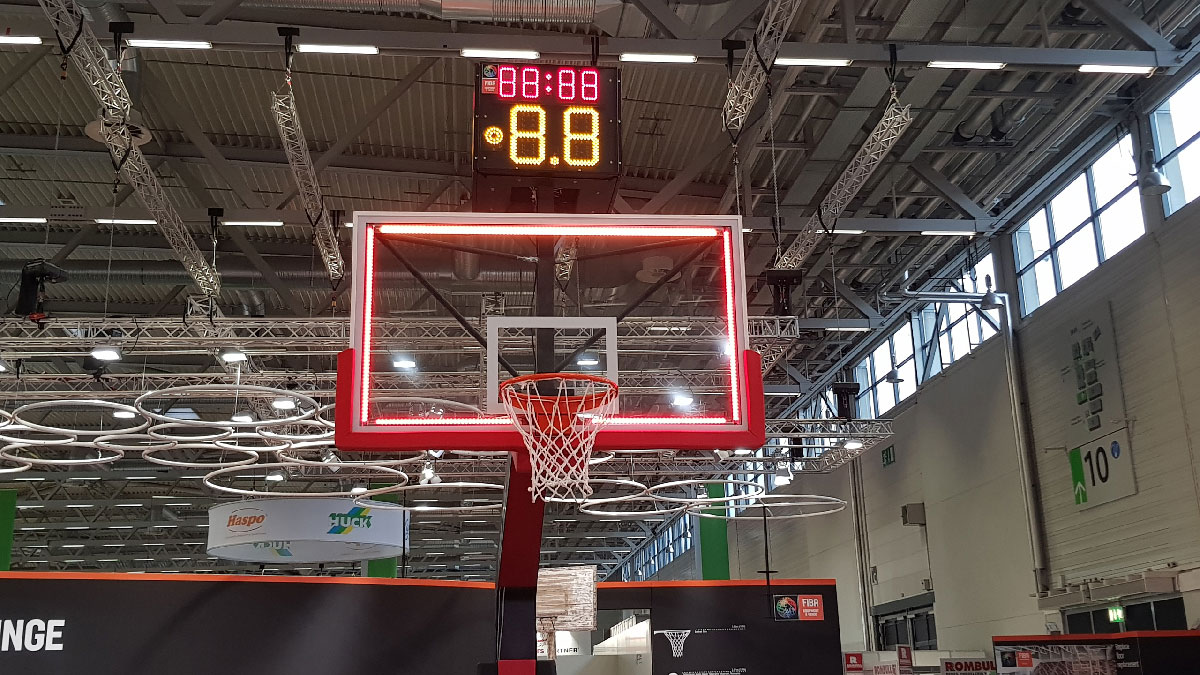
The backboard must be made of tempered or laminated glass, with a thickness between 11.8 mm and 13.5 mm to ensure durability and safety in the event of impact. The standard dimensions of the backboard are 1.80 meters wide and 1.05 meters high. The backboard must be mounted on a solid support structure that keeps it perfectly perpendicular to the floor and parallel to the baseline.
Key features:
- Material: tempered or laminated glass.
- Thickness: 11.8–13.5 mm.
- Backboard Dimensions: 1.80 m x 1.05 m.
The backboard must also be equipped with a light strip that illuminates at the end of each quarter, ensuring clarity during critical moments of the game.
Pressure-release rim
A pressure-release rim is a mandatory requirement for hoops used in high-level competitions (FIBA Level 1). This system is designed to prevent damage to both the hoop and backboard during dunks or other powerful shots. The mechanism is triggered when a force between 82 kg and 105 kg is applied, and the rim automatically returns to its original position after release.
Key features:
- Release mechanism: activated by a force between 82 kg and 105 kg.
- Rotation: the rim can rotate between 10° and 30° before returning to position.
This technology not only protects the equipment but also ensures player safety, reducing the risk of injury during dunks.
Support structure and padding
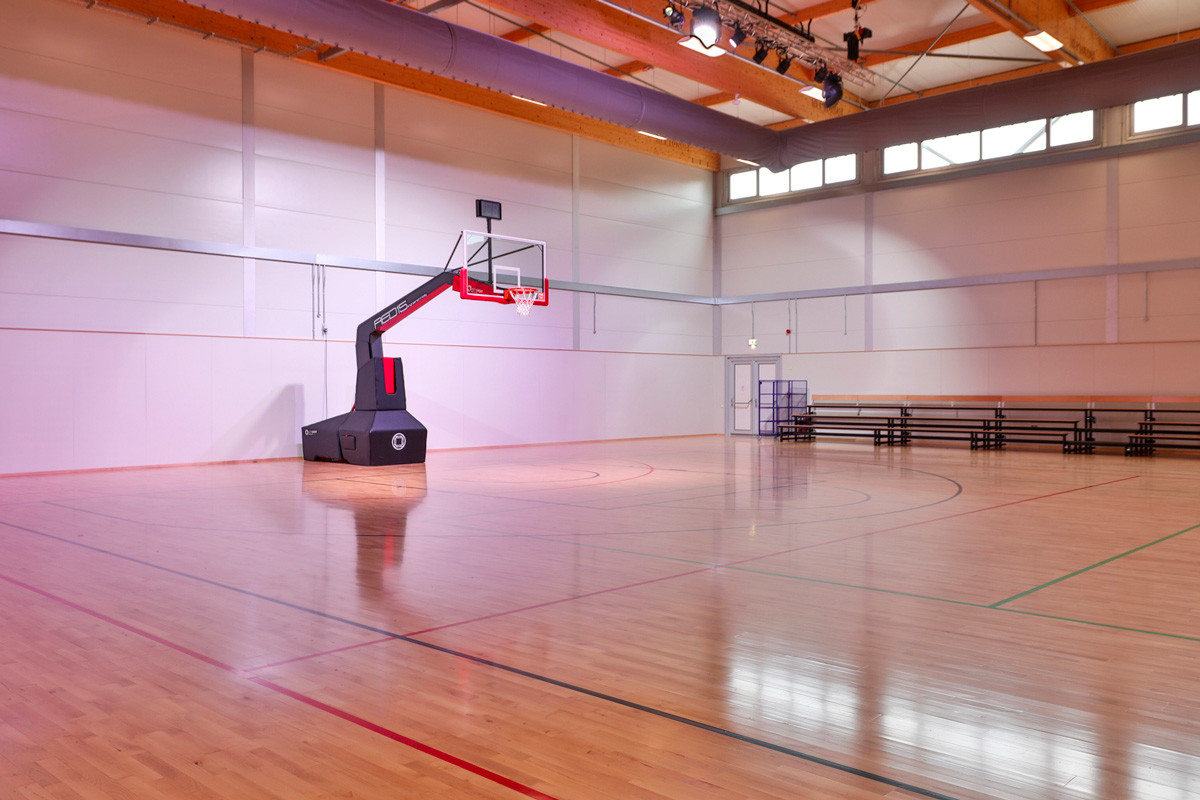
The support structure of the basketball hoop must be stable and designed to minimize vibrations transferred to the backboard. For FIBA Level 1 competitions, the structure must be either mobile or floor-mounted. For Level 2 competitions, ceiling- or wall-mounted systems are also acceptable.
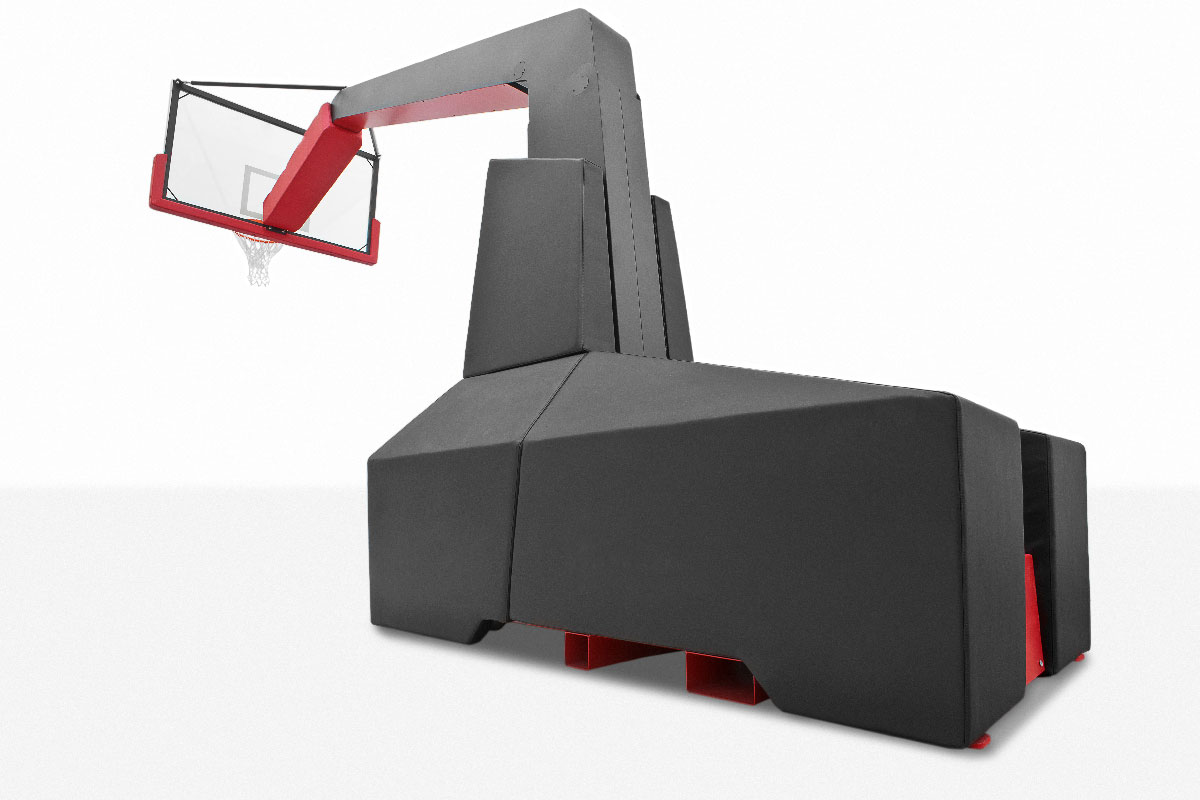
Key features:
- Support Structure: mobile or floor-mounted (Level 1).
- Distance from Baseline: at least 2 meters from the edge of the court to the structure
- Padding: 2.15 meters thick along the sides of the structure, and at least 48–55 mm of padding on the bottom edge of the backboard.
Padding is essential to protect players in the event of accidental collisions, reducing impact and helping to prevent injuries. Additionally, the hoop must be securely anchored to the floor or have a sufficient counterweight system to prevent movement during play.
Key aspects to consider in FIBA-Regulation basketball systems
When purchasing or installing a FIBA-regulation basketball hoop, it's important to ensure that all specifications are met. Beyond dimensions and technical features, there are several key aspects to consider and discuss with your equipment supplier:
- FIBA Certification: Make sure the hoop is FIBA-approved, especially if it will be used for official competitions. In Italy, the certification body for this is Labosport. Ensure that your supplier provides this certification along with the system.
- Certification Level: Verify the appropriate certification level (Level 1 or Level 2) based on the type of facility where the hoop will be installed.
For example, at Artisport, we manufacture a range of FIBA-certified basketball systems at our facility in Italy:
- RED15, MOVE19, B676: FIBA Level 1 and Level 2 certified portable basketball systems with hydraulic mechanisms
- B653:FIBA Level 2 certified wall-mounted basketball system
- B655/1:FIBA Level 2 certified ceiling-mounted basketball system
Conclusion
A FIBA-regulation basketball hoop must meet strict requirements in terms of height, rim dimensions, net, backboard, and support structure. Following these guidelines not only ensures compliance with official rules but also enhances safety and quality of play. Paying close attention to every detail, from hoop height to structural stability, is essential for creating a safe and professional playing environment. Always rely on qualified professionals when selecting a FIBA-certified basketball system.
Posted in:
Basket
Related posts
-
 Basketball equipment: everything you need for training
In this article, the Artisport team of experts provides a guide to choosing the essential equipment for organizing...Read more
Basketball equipment: everything you need for training
In this article, the Artisport team of experts provides a guide to choosing the essential equipment for organizing...Read more -
 Essential basketball equipment: a complete guide for gyms and competitions
In this article, the Artisport team explores the ideal solutions for setting up a gym ready to host basketball...Read more
Essential basketball equipment: a complete guide for gyms and competitions
In this article, the Artisport team explores the ideal solutions for setting up a gym ready to host basketball...Read more -
Grandstands for sports facilities: behind the scenes of their construction
Grandstands for sports facilities are a key element in ensuring the comfort and safety of spectators during sporting...Read more
Leave a comment